Showing posts with label intermediate. Show all posts

August 3, 2010

Vocabulary lesson: Instrumentos Musicais em Português

Bom dia! I was preparing a post about chorinho and thought that it would be a good idea to introduce you to the vocabulary of musical instruments in Portuguese first.  I also have a couple of very nice students who are musicians who may find this useful.

If you are a beginner, don't worry too much if you don't understand a lot of the words in the readings and video, just get as much as you can. If you are an intermediate student, this may be perfect for you. If you are an advanced speaker of Portuguese, you may still learn a new word or two... and I follow the links to some readings that are more advanced.

Parte I: Os Instrumentos Musicais

Aqui estão alguns instrumentos músicais:
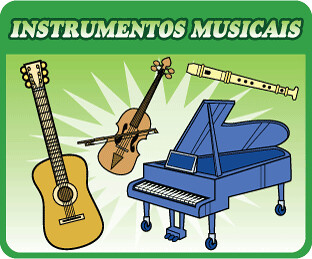
 
 violão, violino, piano e flauta

Esses intrumentos são parecidos (similares), mas são diferentes:


Note que a guitarra é elétrica e o violão geralmente é acústico. O cavaquinho é bem pequenininho.

Aqui estão outros instrumentos:

trombone                       saxofone                       clarineta


                                     gaita

bateria

 
                 pandeiro                                                                                 sanfona


O pandeiro é muito importante no samba e a sanfona é muito importante no forró.
O Slash (dos Guns and Roses) toca guitarra e o João Gilberto toca violão.
Você sabia que o Woody Allen toca clarineta?


Atividades:
Responda as perguntas (answer whichever ones you can):
a. Você toca algum instrumento musical?
b. Você tem algum instrumento musical?
c. Qual é o seu instrumento favorito?
d. Qual dos instrumentos acima é maior (mais pesado)?
e. Qual dos instrumentos acima é menor (mais leve)?
f. Qual instrumento o Kenny G. toca?
g. Dê o nome de um instrumento que é importante no samba.
h. Dê o nome de um instrumento que é importante no jazz.
i. Dê o nome de um instrumento que é importante no rock.
j. Dê o nome de um instrumento que é importante na bossa nova.

Jogue esse jogo sobre instrumentos. Fale o nome dos instrumentos em voz alta.

Opcional: leia esse artigo sobre instrumentos importantes na música brasileira (if you can, don't worry if don't understand everything. Beginners may just read the name of the instruments matched with the drawings) .

Desafio (challenge): play a game of forca (hangman), where all words are instrumentos músicais. (Don't worry if you don't know all of the words in the game: I and a lot of Brazilians wouldn't know all those words ourselves!)


PARTE II: Os instrumentos do Choro

Essa parte é sobre os instrumentos importantes no choro. Para saber um pouco sobre o choro, veja as links no meu artigo sobre o choro.

Atividades:

Leia o artigo Os instrumentos do choro (if you can, don't worry if don't understand everything. Beginners may just read the name of the instruments matched with the drawings).

Advanced students: leia este artigo.

Conecte o nome do instrument com a foto:

Exemplo:
Violão de seis cordas: _1__

cavaquinho: ___
bandolim:___
violão:___
flauta: ___
pandeiro ___


O seguinte vídeo sobre um instrumento importante no choro, no samba e no pagode. Adivinha qual é o instrumento!

Aqui está o vídeo, com perguntas para responder (the host of the quiz doesn't support Portuguese characters, so there are no acentos in the quiz :-( ). Click here to see the complete test.


(If you are a my student in a class or private lessons, ask me for a code to share your results or grab it from our private wiki).

Gente! O Eduardo Sant'Anna não é incrível?

Opcional: leia as partes do violão e escute o vídeo de novo. Você consegue reconhecer alguma parte?


 Now that you know the names of the instruments used in chorinho,  enjoy some of the music!

July 12, 2010

Practice your Portuguese Watching Brazilian Movies at MoMA!

Another great opportunity to watch Brazilian Movies in New York City! Starting this week until the end of the month, MoMA will be showing movies by both new and established Brazilian filmmakers on their Premiere Brazil! Festival. It is a great chance to get expose to the language and different aspects of Brazilian Culture. I will certainly be watching some of the movies with my students. You should go too!

Even if you are not going with a teacher/ class, here are some tips to get even more of the experience (you can apply them to other Brazilian movies you may want to watch too). The idea is to get your mind prepared to the themes, vocabulary and the accent of the movie beforehand, so that you can make the most of it:

  1. Choose the movie you want to watch. I recommend you choose based on your interests (i.e., whatever looks more fun for you)... but if you want to worry about other things, remember that movies that are very urban, with gangs etc. (like City of God) are possibly more challenging (which can be good if that is what you are looking for). You can also see if there is any information on the description about the region where the movie is set: if it is set in the same region as your teacher/ materials are from, it may be easier to understand (materials often show features of São Paulo and Rio accents). If it is set in a different region, it may be harder, but also very interesting! If my students want to watch more than one movie, I usually suggest that they try and choose movies that look like they will feature different types of language (e.g.: a rural setting and an urban setting or a move set in the Northeast and one in São Paulo), to widen their exposure.
  2. Look at the cover/a picture/poster of the movie. Try and imagine what the movie is about. Make a couple sentences describing what you guess the movie is about (in Portuguese).
  3. Find a description of the movie from its promotional materials, read it out loud. Underline any words you don't know and either look them up or ask your teacher to help. Now, write or say your own short description, without looking and in your own words (in Portuguese).
  4. See if you can find a movie trailer and some clips of the movie. Listen to it a few times to get used to the accent. Try and repeat/ act out one of the scenes out loud. Repeat any words that you liked or where you found the pronunciation different or interesting.
  5. Think about what you know of the story so far and formulate a few questions about parts of the story that you don't know, so that you can answer them after the movie? Write a small list of questions down. These can be any questions, for example Qual é o relacionamento entre a mulher loira e a morena no poster do filme? (What is the relationship between the blond woman and the brunette woman in the movie poster?), Porque a mulher loira está correndo naquela cena do trailer? (Why is the blond woman running on that scene on the trailer?). You can see if you can answer your questions after the movie.
  6. Read the questions under number 7 below ("7.Review the movie") to see some aspects of the movie that you may want to notice (optional - you may just want to enjoy the movie instead).
  7. Enjoy the movie!
  8. Review the movie. If you have a teacher or a friend who speaks Portuguese, discuss the movie with him or her. there are may things you can talk about, here are some suggested topics (you should discuss it in Portuguese, of course):
    1. Plot and characters: Summarize the plot. Say what you thought about the story in general, about each of the main characters. What was your favorite character? How did you feel during the movie (assustado, triste, feliz, emocionado)?  Did the movie make you rir ou chorar (laugh or cry)? If so, in which scenes? Did you like the ending? Would you have changed it?
    2. Photography: Was the movie visually appealing? Was the 'look' of the movie (dark and heavy? Light and airy?). What were your favorite scenes (visually) in the movie? Can you describe one of the scenes, places or settings in the movie? (e.g. an old house)
    3. Cuture: Did you learn anything new about Brazilian culture? Was there anything that you found interesting? Was there any habits/ actions practiced by the characters that you didn't understand?
    4. Language: Was the language easy or difficult to understand?  Did you recognize and words or expressions that you already knew? Which ones? Do you remember any new words/ expressions that you found interesting? Was the accent of the characters similar or different from what you are used to? If so, did you notice how the accent was different (e.g., the pronunciation of the 's', intonation etc.).
  9. Write about the movie. Write a summary or review of the movie.
 ... or if you don't want to focus on learning so much this time, just go and enjoy the movie!

June 28, 2010

Portuguese for the world Cup -Part 1: Basic Conversation Soccer Terms

Even if you are in the US, chances are that you have heard about the hype about the Copa do Mundo (The FIFA Soccer World Cup). Whenever the Copa comes up, it is also likely that you hear at least some talk about Brazil (since Brazil is the only country to have participated in all world cups, the only one to have won 5 times and the top country in historical ranking... ok, I'll stop now...). .. Even if you are not crazy about futebol, it is nice to add a little soccer vocabulary to your Portuguese, since it is so present in Brazilian culture.

The game (Brazil x Chile) is starting really soon, so I will make this a quick starting post, with more coming later. Here are a couple of terms you may hear if you go watch it in a bar or a Brazilian friend's house to get you started:

1. Basic terms:

Copa (do mundo) - world cup
Futebol - soccer

Partida/ jogo - match/game
Assistir - watch
bola (de futebol) - (soccer) ball
jogador - player

Exercises:
1. Make sentences with each of the words above, until you have used all the words (not necessarily in the same sentence). If you are a beginner, you may still be able to make very simple sentences slightly modifying the examples. Example: 

Kaká é um jogador de futebol.
Eu não assisto todos os jogos da copa do mundo.
O meu amigo tem uma bola de futebol.

2. Answer if you can:
a. Que é o seu jogador favorito?
b. Você está assistindo os jogos da copa do mundo?
c. Qual foi a sua partida favorita?
d. Você tem uma bola de futebol?


2. Torcer (para)

The verb for cheer is torcer (use it with para to say who you are cheering for). E.g.:

Torcer (para):

Para quem você está torcendo?
Who are you cheering?


Eu estou torcendo para o Brasil.
I am cheering for Brazil.

Eu estava tocendo para o México.

I was cheering for Mexico yesterday.

You can also use this verb to say which team you support in general:

Na copa do mundo, eu sempre torço para o Brasil, mas a minha esposa torce para a Argentina.
In the world cup, I always support (cheer for) Brazil, but my wife supports Argentina.

Eu torço para o Lakers.
I support the Lakers/ I'm a Laker's fan.

Exercises: 
a. Make 2 sentences saying which teams you support in any sport you like. 
b. Make 3 sentences saying which teams people you know support.
c. Practicing asking someone which team they are cheering for.

3. Soccer terms:

If you know a little bit about soccer you may like to know these terms. I took them straight from this nice article (which teaches English soccer terms to Portuguese speakers):
  • EscanteioCorner kick
  • ÁrbitroReferee
  • TécnicoCoach ou Team Coach
  • AtacanteStriker
  • Zagueiro Defender
  • LateralWinger
  • Goleiro Goalkeeper
  • Meio campo Midfielder
  • Impedimento- Offside
  • Lateral (cobrança)Throw-in
  • Penalti Penalty kick
  • Torcedor Supporter/fan
  • BandeirinhaLinesman
Exercises:
This exercise is only recommended for those  into soccer and it may be a nice prep before watching a game (assuming Brazil wins today :-)).
1. Do a little research and describe in Portuguese sentences, using the terms above:
     a. The Brazilian team in a recent game;
     b. Either (i) the team you support (if not Brazil); (ii) a team you recently watched, or; (iii) the team who is next playing Brazil.
E.g.:
    O Dunga é o tecnico do Brasil.


This should give you a little bit to start speaking a little Portuguese on the next game... For now, see you after Brazil x Chile!

February 17, 2010

Impersonal expressions in Portuguese

***Warning: grammarphobes may want to skip this article. If you want to learn some of the points here more implicitly, you can practice the expressions here or here. I am adding a category 'avoid if you don't like grammar' so you can stick to the less heavy stuff.***

One of my students asked about impersonal verbs this week, so I thought I would share this with you in case you have similar questions...

...But wait. Don't Brazilians like to get personal? Fear not, you can hold on to the friendly Brazilian stereotypes :-). I don't mean impersonal in the sense of unfriendly or cold. This post is about impersonal in the sense of lacking person agreement (the different person conjugations) on the verb. If you have no idea what I am talking about, don't worry. I'll explain. (If you know what I am talking about you can skip the re-cap :-))

A. Re-cap: (Person) Verb Conjugation 101

Remember that for beginners it can sometimes be tricky to remember all those different verb endings? For example, take the verb falar (to speak) in the past (you can also look at ser and estar):

(1)Eu falei
(2)Você/ele/ela/a gente falou
(3)Nós falamos
(4)Vocês/eles/elas falaram

See how the verb endings are different depending on the subject? These different forms depending on the subject is what I am calling person agreement/ person conjugation. Compare with the English translation, where the verb doesn't change at all:

(1) I spoke.
(2) You/he/she/we spoke
(3) We spoke
(4) You/they spoke

That is because English shows no person agreement for the verb 'speak' in the past and Portuguese does.*


B. Impersonal verbs

If you have trouble remembering the endings you may like this. Not all verbs have different forms for different persons like the ones above. There are verbs that don't have different endings for different subjects... because they have no subject at all!

If you look up 'impersonal verbs' on a grammar, you will probably get the typical impersonal verbs, like some verbs describing the whether:

Nevou muito em Nova Iorque ontem.
(It) snowed a lot in New York yesterday.

The verb nevar in the simple past is always nevou. There is usually no nevei, nevamos, etc. Similarly, in English you can't use different subjects. You can only say 'it snowed', but not 'I snowed', 'we snowed'. Etc.

So we see two properties of impersonal verbs in Portuguese from the example:

Impersonal verbs:
(1) There is no subject
.
(2) There aren't different person conjugations.


There are other 'classic' impersonal verbs (e.g., haver/ter (= English 'there is') , meaning to exist). There are also plenty of other expressions that are not these classic impersonal verbs that are grammatically impersonal. Here are a couple of examples of informal examples that we saw on this blog:

We saw one on the last post on cair a ficha (meaning something like 'to click'), notice how the verb cair doesn't change depending on the person:

Eu não estava entendendo nada, mas ontem finalmente caiu a ficha!
I wasn't understanding anything, but yesterday it finally clicked.

Nós não estavamos entendendo nada, mas ontem finalmente caiu a ficha!
We weren't understanding anything, but yesterday it finally clicked.

Eles não estavam entendendo nada, mas ontem finalmente caiu a ficha!
They weren't understanding anything, but yesterday it finally clicked.

The verb dar in the expression dar para (meaning something like 'to be possible (for)') is also impersonal (even though the second verb is):

Não deu para eu chegar cedo ontem.
(It) wasn't possible for me to arrive early yesterday.

Não deu para eles chegarem cedo ontem.
(It) wasn't possible for them to arrive early yesterday.

Não deu para nós chegarmos cedo ontem.
(It) wasn't possible for me to arrive early yesterday.

We will certainly be seeing some more examples of impersonal verbs come up on this blog, though we won't be discussing the grammar so explicitly every time (grammar tips are good in small dosis).

Exercises:
1. Read the blog posts on the expressions 'cair a ficha' and 'dar para' if you haven't already done so (take your time. Don't do everything today!). Do the one exercise there.

2. Google the following phrases to get more examples of these expressions (use the double quotes). Copy 6 sentences that you understood:
a. "deu para eu", "dava para eles", "não dá pra eu", "não da pra elas" (note: pra is an informal reduced version of para)
b. "choveu", "neva", "ventou"
c. "caiu a ficha", "cai a ficha"

3. Write six sentences of your own with the expressions in 2a, b and c.

*English does have some person agreement, but it shows up in only a few cases. If you look at the verb 'speak' in the present (or any regular non-modal verb), you can see that there is a different form of the verb that depends on person. We say 'I speak' and 'she speaks'. This is an example of person agreement. Another example is the verb 'be'. In this case we also have different forms (am,are,is) for different persons, even in the past ('was', 'were').

February 15, 2010

Portuguese Expression: "Cair a Ficha"


1965 duas tribos Originally uploaded by cavern club
Used with permission by photographer

Caiu a ficha
is a very common slang which literally means for a 'the token dropped'. It means something like 'it dawned on me/someone', 'it clicked', 'I/someone got it' to start understanding something that may have taken a while to understand:

O professor explicou várias vezes o problema eu não entendia. Quando ele finalmente mostrou um exemplo, caiu a ficha.
The teacher explained the problem several times and I didn't understand. When he finally showed an example, it clicked/ I got it.

It is often used in the sense of 'taking a hint':

Eu sempre digo que estou ocupada quando ele me convida para sair, mas mesmo assim não caiu a ficha que eu não quero sair com ele!
I always say that I am busy when he asks me out, but even then, he hasn't gotten it yet!

The source of the expression becomes a little clearer if you know a little bit about Brazilian public phones. These are known as orelhão, litererally 'big ear' because of their shape (see the picture above by cavern club... can you see how it is kind of shaped like an ear?).

Back in the day, to make a call on a public phone, you needed to buy a phone token (we didn't get to use quarters like here... maybe because of the inflation, they would probably have had to change the phones too often to accept different shaped coins!). When you placed a call the token would stay up towards the top of the phone until someone picked up on the receiving end. When they picked up, the token would drop into the phone (at that point you could not get it back).

Caiu a ficha?

P.s.: I just got told that they have the same expression in hebrew! Something like "the token fell" (nafal ha asimon).

June 19, 2009

Expressions of age in Portuguese

My birthday was earlier this month. (Check out these other posts, if you want to know how you would sing happy birthday in Portuguese)... So we will cover a couple expressions for different ages in Portuguese, starting with balzaquiana, em minha homenagem (=as an homage to me):

balzaquiana = woman in her 30s.

Example:

Agora, eu sou uma balzaquiana.

This is due to Balzac's "A woman of Thirty". There is no similar term for men, so you can say the following (applicable to men and women):

Ele tem uns vinte/trinta/quarenta e poucos anos.
He is in his early 20s/30s/40s.
(literaly something like: He has some 30 and few years)

Ela tem uns vinte/trinta/quarenta e tantos anos.
She is in her late 20s/30s/40s.
(literaly something like: She has some 20/30/40 and so much years).

Exercises:

  1. If you are of applicable age, make a sentence describing your age, using the expressions above.
  2. Think of a couple of people you know and use the expressions above to describe thier approximate age.

As well as balzaquianas, we also have women in the idade da loba:

a idade da loba - literally "the age of the female wolf" - the age of women in their 40s

This is again due to a book by Regina Lemos (the translation of the title would be "Forty: the age of the wolf" - but all using the feminine gender. Here is some more on that). Again this is for women only.

For both genders, we can use the following expressions for people in their 40s and 50s (very informal):

quarentão/quarentona
in his 40s/ in her 40s

cinquentão/cinquentona
in his 50s/ in her 50s

Finally we have:

coroa - a slang meaning old person (sometimes pejorative) - literally "crown"

and

enxuto/enxuta - a slang meaning someone well preserved for their (old) age.

Example:

Ele é um já é um cinquentão, mas está um coroa enxuto.
He is already in his 50s, but he is a well preserved old man.

Exercises:
  1. Think of someone you know or celebreties ranging from early 20s and 50s. Make sentences describing their ages.
  2. Answer if you can: Na sua opinião, quais pessoas famosas são coroas enxutos?
Bom, agora que sou balzaquiana, espero que , pelo menos eu seja uma coroa enxuta!

April 17, 2009

Expressions of Frequency in Portuguese

The blog is back! ... and the plan is to have a post per week. To get started, how about we look into how to say "once a week" and other similar expressions in Portuguese?

Once/twice a week:

Eu escrevo no blog uma vez por semana.
I write on the blog once a week.

... uma vez por semana. (once a week)
... duas vezes por semana. (twice a week)
... três vezes por semana. (3 times a week)

You can also use this expression for other time periods:

Eu viajo para o Brasil uma vez por ano.
I travel to Brasil once a year.

Eu vou ao cabeleleiro uma vez por mês.
I goes to the hairdresser once a month.

Exercise: Think of an activity that you do once a week and make a sentence in Portuguese expressing that. think of an activity that you do more than once a week and make a nother sentence. Example: Eu visito os meus pais uma vez por semana. Eu faço ioga duas vezes por semana.

Everyday:

= todo dia (slightly more casual) or todos os dias (slightly more formal):

Eu tiro foto todo dia.
I take pictures every day.

Eu chego ao trabalho às 9:00 todos os dias.
I arrive at work at 9:00 every day.

Exercise: Answer the question: Você estuda Português todo dia?

Every other day:

I like this one. To say every other day, you can literaly say: "one day yes, one day no": um dia sim um dia não:

A Mariana corre na praia um dia sim um dia não.
Mariana runs at the beach every onther day.

Exercise: Answer the question, if you can: Você tem tempo para estudar português um dia sim um dia não?

Once every X days:


You can express every X days by using the expression uma vez a cada X dias. For example, to say "once every three days" you say uma vez a cada três dias:

Eu vou na academia uma vez a cada três dias.
I go to the gym once every three days.

Update: Every Once in a While

You can say de vez em quando:

De vez em quando, eu vou caminhar no Central Park.

Every once in a while, I go for a walk in Central Park.

Exercise:
- Make a table scheduling your major regular activities for the week.
- Based on your table describe your regular activities. Make sure to use each of the four types of expressions that you learnt at least duas vezes!

Bom, that is it for now. I hope to see you here at least uma vez por semana.

October 1, 2008

Talking about Travel in Portuguese 3: travelling by plane

Quanto tempo! (again)... Now that I have finally finished settling in in Nova Iorque, I am back from my sumiço (=disapearance). Completing our travelling series, here is a dialogue describing a trip. If possible, try to get the main gist from the Portuguese version and the glossary before peaking at the English translation. (More vocabulary coming up in a future post).

Diálogo:
Thomas: - Ananda, como foi a sua viagem para LA?
Ananda: - Foi bem legal, mas o vôo de volta foi bem longo.
Thomas: - Ah é? Foi um vôo direto, ou você teve conexões?
Ananda: - Eu tive uma conexão em Chicago. Foi bem demorada... mas a passagem foi bem baratinha!
Thomas: - Que bom! Por que? É baixa-estação?
Ananda: - Nem sei se é alta ou baixa... mas foi barata porque eu comprei a passagem pelo programa de milhagem.
Thomas: - Legal!

Notes:
  • A volta: the way back on a return flight. A return flight is called ida-e-volta, consisting of a vôo de ida (flight there) and vôo de volta (flight back).
  • Vôo direto: direct flight, with no conexões (connections) or escalas (stop-overs).
  • Bem + Adjective, as in bem longo or bem baratinha: Although bem literally means 'well', in these cases it is used to instensify the meaning of the adjective, much in the same way of the word 'very' in English.
Loose Translation:
Thomas: - Ananda, how was your trip to LA?
Ananda: - It was very nice, but the flight back was very long.
Thomas: - Really? Was it a direct flight or did you have connections?
Ananda: - I had a connection in chicago. It took a long time... but the ticket was very cheap!
Thomas: - Great! Why? Is it low season?
Ananda: - I am not even sure if it is low [season] or high [season]... but is was cheap because I bought the ticket through the millage program.
Thomas: - Cool!

Exercícios:
1. Como foi a minha viagem para LA? E o vôo de volta?
2. Porque a minha passagem foi bem baratinha?
3. Você faz parte de um programa de milhagem? Em que companhias aéreas?
4. Qual foi o vôo mais longo que você já fez? Para onde foi? O vôo teve escalas ou conexões?

September 12, 2008

Expressions with dar: 'Dar para' em Portuguese

Today's tip will show you how to use the expression dar para in Portuguese. This is a very natural and common way to say that something is possible/ doable. Here are a couple of examples:

Dá para ver a cidade inteira do topo da Sears towers!
One can see the whole city from the top of the Sears towers.

Não dá para dirigir de Los Angeles até Nova Iorque em um dia: é muito longe!
One cannot/ It is not possible to drive from L.A. to NY in one day: it is too far!

Com a nova ponte, vai dar para chegar em casa bem rápido.
With the new bridge, it will be possible to arrive home very quickly.

Mini-dialogue:

(Ananda:) Eu fui no MoMA ontem ver a exposição do Dali, mas não deu pra ver nada: estava muito cheio!
I went to MoMA yesterday to see the Dali exhibition, but one could not see anything: it was too full!

(Dju-Dju:)É, quinta-feira é muito cheio... Amanhã vai estar menos cheio e vai dar para ver melhor.
Yeah, Thursday it is very full... Tomorrow it will be less full and it will be possible to see better.


Deu para entender os exemplos?
Was it possible to understand the examples?

So the structure is:

DAR PARA + VERB(infinitive)
to roughly mean: It is possible to VERB

1. Exercise: Answer however many questions you can:
1. Dá para dirjir de Nova Iorque até Los Angeles em um dia?
2. Dá para dirjir de Nova Iorque até Los Angeles em cinco dias?
3. Dá pra ver o mar da sua janela?
4. Dá para pegar (pick up) a Internet dos vizinhos na sua casa?

Have a look at the verb dar in the examples. Did you notice they are always the verb form (conjugation) for ele (dá, deu, vai dar). That is how you always use the verb in this expression (with the third person singular form of the verb).

That is not to say that you can't 'personalize' them a little bit by saying that an action is possible/doable for specific people, as in the following examples:

vai dar para ela chegar em Nova Iorque em três dias.
It will only be possible for me to arrive in New York in three days.

Não deu para eu ir no seu aniversário: eu estava muito ocupada.*
It was not possible for me to go to your birthday: I was very busy.

Não dá para eu ler o cardápio: eu esqueci os meus óculos.
It is not possible for me to read the menu, I have forgotten my glasses.

Dá para você abaixar o volume do seu som, por favor?
Is it possible for you to lower the volume of your stereo, please?

In this case, the structure is like this:

DAR PARA + (EU/VOCÊ/ A MARIA...) + VERBO
It is possible for me/you/Maria... to VERB

Notice that the verb dar is still the form for ele (dá, deu, vai dar...).**

Now let's practice again:

1. Exercise: Answer whichever questions you can:
1. Dá para você ver o mar da janela do seu quarto?
2. Vai dar para você ir no Brasil este ano?
3. Dá para você pegar a Internet dos vizinhos na sua casa?
4. Deu para entender esta dica (=tip)?
5. Dá para alguém dirjir de Nova Iorque até Los Angeles em um dia?

Espero que dê para você usar esta expressão agora!

Até a próxima!

*Advanced speakers only: Brazilians have a lot of trouble deciding what form of the pronoun to use over there. I've used the form considered correct in written Portuguese, but colloquially many people may use mim instead of eu.
**The second verb changes for eles and nós... but this will be the tópic for another tip...

August 26, 2008

Talking about Travel in Portuguese 2

Celebrating a road trip to NYC, we've done a dialogue about travel (you may look there first). Now let's review some more expressions related to traveling...

Modo de transporte (Means of transportation):
Viajar/ ir... (travel/ go)
de carro (by car)
de avião (on a plane)
de trem (by train)
de barco (on a boat)
de navio (on a ship)
de bicicleta! (like my friend Eric Fiala)
a (on foot!)

Exercises:
1. Construct two sentences with the expressions above.
2. Answer what you can:
a.Você já viajou de navio? Aonde você foi?
b.Você viajaria a outra cidade de bicicleta?

Na estrada (on the road):
pagar pedágio (to pay a toll)
ultrapassar (to pass)
estrada, pista (road)
faixa (lane)
posto de gasolina
multa por excesso de velocidade (speeding ticket)
milhas/ quilômetros por hora (mph/kph... it might be useful to review numbers)

Exercicios:
1. Answer however many questions you can:
a. Tem muito pedágio no seu estado?
b. Você paga pedágio no caminho para o trabalho?
c. Qual é a faixa usada para ultrapassar?
d. Você já levou uma multa por execesso de velocidade? Onde você estava? Qual era a sua velocidade?

Distâncias:

Los Angeles está/ fica a 2.700 (dois mil e setessentas) milhas de Nova Iorque.
(Los Angeles is/ is located 2,700 miles from New York).

Union City está/ fica a 5 milhas de Nova Iorque.
(Union City is/ is located 2,700 miles from New York).

Los Angeles fica longe de Nova Iorque.
Union City fica perto de Nova Iorque.

Exercises:
1. Answer what you can:
a. O seu trabalho fica perto da sua casa?
b. A sua cidade fica perto de Nova Iorque?
c. Qual é a distância entre a sua casa e a praia?
d. Qual foi a maior viagem de carro que você já fez?

2. Write a couple of sentences describing a trip that you have done. You could tell your means of transportation, who went with you, where, the distance...

[Feel free to post your answers!]

Te vejo em Nova Iorque!

August 16, 2008

Talking About Travel in Portuguese

Quanto tempo! (= long time no see, lit. "how much time!"). Although I don't think I have much of a regular following (yet?), I feel I should appologize for my long absence. I have been camping and hiking in somewhat remote places (part of a road trip from LA to New York City), unable to post any Portuguese wisdom. Now that I have the basics (a cell phone connection and a power supply), we are ready for a special travel edition (i.e., basic with no links, as I am typing this from a cell phone).

In this post, you can learn some new expressions with a conversation (see what you understand on your own first, then look at the notes on new expressions... only then look at the translation... then practice!):

Conversation:

Ananda: - Dan, você prefere viajar de carro ou de avião?
Dan: - Ah, depende. Dirigir é legal... mas não se a distância é muito longa...
Ananda: - É mesmo... mas eu não gosto de tomar 'chá de aeroporto'...
Dan: - É... fazer o check in, as filas, preocupação com a segurança, bagagem... muito chato!
Ananda: - ...e de carro dá para ver a paisagem, parar para ver lugares diferentes...
Dan: ... Vamos dirigir até Nova Iorque, em vez de ir de avião?
Ananda: - Bora!

Expressions:

  • Tomar chá de aeroporto literally means "to have airport tea" is a slang expression which means to have to wait around the airport. Another common variant (even more common) of this expression is tomar chá de cadeira ("to drink chair tea"), meaning to be made to sit down and wait around (for example while waiting for a doctor's appointment or for a friend who is late).
  • Bora! - is derived from vamos embora (let's go (away)) and it means "let's go" or "let's do it". You can combine it with other verbs to mean "let's do X" (where X is the verb). For example, "bora comer" means, "let's eat".

Translation:

Ananda: - Dan, do you prefer traveling by car or by plane?
Dan: - Oh, it depends. Driving is nice... but not if the distance is very long...
Ananda: - That's right... but I don't like having to wait around at the airport [see glossary].
Dan: - Yeah... doing the check in, the lines, worry about security, luggage... very annoying!
Ananda: = and by car one can see the view, stop to see different places...
Dan: - Let's drive to New York rather than going by plane?
Ananda: - Let's do it!

E você: prefere veiajar de avião ou de carro?

July 25, 2008

Basic Computer Terms in Portuguese

Are you sitting in front of the computer? Great! (sorry, iPhone users). Let's learn how to talk about it in Portuguese. Ready?

Let's start, repeat after me: software, hardware, mouse... that was easy, huh? :-) A lot of Portuguese computer terms are really easy to learn, because they are really just straight borrowings from English (advanced students may like to read this rant against the use of estrangeirismos (foreign words) in Portuguese by the IT industry). As with any borrowed words, the fun lies in pronouncing them the Brazilian way way, so:

software
[softchyweh], hardware [hahdjiweh], mouse [mouzy].

Computer Parts:
Now look at your computador (it is masculine, so you say o/meu/seu computador):
Here is some more, if you are into hardware (you may also look here):
O disco rígido (the hard disk)
O processador (can you guess?)
O leitor/gravador de CD/ DVD (the CD/DVD reader/ writer)
A Memória RAM
A placa mãe (the mother board)

Actions:
Ligar/ Desligar o computador (to turn the computer on/off)

Clicar ... (To click)
... o botão direito/ esquerdo do mouse (the right/ left mouse button)
... na link (the link)

Fazer um clique duplo or clicar duas vezes (to double click)

Abrir/ Fechar... (open/ close)
... a janela (the window)
... o arquivo (the file)

Selecionar (to select)
Salvar
Apagar (or deletar)
Copiar
Editar
Imprimir (print)

Exercises:
A. Read the article. Now minimize the article, look at your computer and name its parts. How many terms can you remember? Check the terms you missed and repeat. Did you improve your score?

B. Answer the questions you that you can understand (or try your best guessing their meaning):

  1. Qual é o processador do seu computador? (e.g. "Intel"/ "AMD")
  2. O seu computador tem um gravador de DVD?
  3. Qual é a marca (=brand) da sua impressora?
  4. Qual é o tamanho da sua tela? (exemplo: 14 polegadas (=inches))
  5. Quantas janelas estão abertas na sua tela agora?
  6. As suas caixas de som são boas?
C. Make sentences with the actions above. Here are a couple of examples:

Para abrir uma janela nova, eu cliquei nessa link.
To open a new window, I clicked in this link.

João, salva o documento nessa janela e desliga o computador para mim, por favor.
John, save the document in this window and turn the computer off for me, please. (informal)

Uau! A foto naquela janela é muito bonita! Eu vou copiar e imprimir ela para você.
Wow! The photo in that window is very pretty! I will compy and print it for you.

July 9, 2008

Happy Bithday in Portuguese 2

Here is a little more on singing happy birthday in Brazil.

Right after singing the standard happy birthday song, people may also sing this song as a joke (in the same tune as the happy birthday song):

Parabéns pra você
Eu so vim pra comer
Esqueci do presente
Nunca mais vou trazer

When the birthday boy or girl is single, people may also add the following song:

Com quem será
Com quem será
Com que será que o/a [Name of bithday boy/girl] vai casar?
Vai depender
vai depender
vai depender se o [Name of potential love interest]** vai querer
Ele/ela aceitou
Ele/ela aceitou
Tiveram dois filhinhos e depois se separou

The name of the love interest usually agreed upon amongst the party guests (without consulting the birthday girl/boy) to be someone of the opposite sex who is present at the party, as a potentially embarrassing joke.

Happy Birthday in Portuguese

Today is my lovely mom's and her twin sister's birthdays (Parabéns, gatíssimas!). Here is a happy birthday song for them:

Parabéns pra você
Nesta data querida
Muitas felicidades
Muitos anos de vida!*

This is the simple song that most people sing. If the crowd is really enthusiastic (which is true in this case), they would keep on singing a second song (not everyone does this, and there are variations):

Chegou a hora de apagar a velinha
Vamos cantar aquela musiquinha
Parabéns pra você
Parabéns pra você
Pelo seu aniversário
Parabéns pra você
Parabéns pra você
pelo seu aniversário.


Here is an example a video with both songs.

After the song is over, we say, while clapping (don't ask about meaning, because I don't know! :-)):

É pique! É pique! É pique, é pique, é pique!
É hora! É hora! É hora, é hora, é hora!
Rá-tim-bum!
"Teresa/Tetê"! "Teresa/Tetê"! "Teresa/Tetê"! [these are their names]

Here is an example (after their intro)... and here is another very cute person trying.

So here, it is. We can all sing Parabéns to my mum and aunt.

Feliz aniversário pra vocês, Mãe e Tia Tetê! Tudo de bom pra vocês!

Here is the Google Translate translation of this post (pretty good, but use at your own risk :-)).

July 6, 2008

A Great Website for Portuguese for Spanish Speakers

If you know Spanish, learning Portuguese is really great! You get a ton of vocabulary and grammatical structures for free, which you can use very soon after learning some basics on the pronunciation. (If you have not heard much Portuguese yet, you may try just reading some text first, to start appreciating the similarities)... but it is not all easy: since the languages are so similar, it is very easy to get confused where they do differ. It can be really tricky to separate them (to have an idea on the types of differences you can have a look here (written in Spanish)).

Because of that, it is very useful for Spanish speakers to learn through a program especially for them, focusing on speeding up on the similarities and giving you a lot of practice on the differences. This is exactly what you can find at Tá Falado, an excellent resource including podcast lessons and notes put up by the University of Texas Language Technology Center... and it is all free too. Definitely worth a try for the Spanish speakers.

A final note before you start: I find from observing myself and my students that the hard part is not to understand what the differences are. The real challenge is to remember them when you are speaking. So don't just read the notes at Tá Falado and consider yourself done: really practice each lesson extensively so that it becames part of your speech.


July 4, 2008

'Ter' versus 'estar com'

We have seen the difference between ser and estar... Ter and estar com form another pair that can be confusing, this time for both English and Spanish speaking learners.

Like in Spanish, to say you are cold, hungry, sleepy etc., in formal Portuguese you use ter (have):

Tenho frio/ calor/ fome/ sono. (Written Portuguese)
Tengo frio/ calor/ hambre/ sueño. (Spanish)
I am cold/hot/hungry/tired.

... though we sometimes see this in written text, it sounds very unnatural. In spoken Brazilian Portuguese, it is much more natural to use estar com to say these things:

Eu estou com frio/calor/fome/sono.

[Suggestion: At this point, you may try to make simple phrases on your own now using estar com with different persons (você, a gente, eles...) and different words you may know (frio, medo, sede, raiva, muita pressa, vontade de comer chocolate)... If that is easy, try making up small dialogues using other expressions you may know, e.g.:

João: Você quer água?
Maria: Quero sim. Eu estou com muita sede.]

The main difference between the two is very similar to the difference between ser and estar: In general, Ter is more appropriate to express conditions that are somewhat permanent, whereas estar com is best for temporary states. (... so since frio/calor/fome/sono above are things that are normally temporary, estar com is the best form to be used with them). We can see this more clearly from the following examples:

Eu tenho medo de cachorro.
I am (always/permanently) afraid of dogs.

Eu estou com medo daquele cachorro.
I am afraid of that dog (right now).

Ele tem raiva de todos os politicos.
He is (permanetly) angry at all politicians. ( since he hates all politicians)

Ele está com raiva da Maria, mas vai passar.
He is angry at Maria, but it will pass.

This can also happen in cases indicating possession:

Eu tenho um carro importado.
I have/own an imported car.

Eu estou com um carro importado hoje, emprestado do meu chefe.
I have (temporarily) an imported car today, borrowed from my boss.

Did you get the difference? Now, you could practice by trying to make sentences that emphasize the difference (like the ones immediately above)... or you could do search for estar com to see how people use it on the Internet... Meanwhile, eu já vou: estou com fome!